Digital Licensing & Key Knowledge Base
The State of Digital License Reallocation & Activation Security in 2026
The secondary software and gaming license market enters 2026 under unprecedented regulatory scrutiny and shifting platform enforcement architectures. Following landmark European Court of Justice rulings, principally CJEU Case C-128/11 (UsedSoft v. Oracle) and statutory protections codified under EU Directive 2009/24/EC, the legal principle of copyright exhaustion remains firmly recognized across the European Economic Area. When a copyright holder markets a perpetual license copy, their exclusive distribution rights over that specific digital unit are exhausted. However, the commercial reality of secondary marketplaces has evolved from basic peer-to-peer exchanges into complex multi-tiered brokerage ecosystems, requiring buyers to distinguish between legitimate surplus reallocation and unauthorized entitlement exploitation.
Major platform gatekeepers, including Microsoft, Valve (Steam), Sony Interactive Entertainment, and Electronic Arts, have transitioned activation verification from static product keys to continuous telemetry and hardware hashing. In enterprise and desktop environments, Windows 11 (24H2) enforces stringent Hardware ID (HWID) binding, altering how motherboards and TPM 2.0 modules interact with digital entitlement tokens. While genuine Retail (FPP) licenses retain documented transfer rights under Microsoft Service Agreements, Original Equipment Manufacturer (OEM) keys remain permanently tethered to initial motherboard topologies. Crucially, circulating Volume Licensing allocations (Multiple Activation Keys / MAK) continue to represent high revocation risks when illicitly fractured into consumer retail units, causing widespread activation error codes such as 0xC004C003 once enterprise audit ceilings are tripped.
Concurrently, digital game distribution has seen intensified regional price decoupling and currency tier restrictions. Gray-market listings frequently exploit geographic currency differentials across Latin America, South Asia, and Eastern Europe. However, automated platform anti-fraud heuristics now systematically flag VPN-mediated activations and SubID mismatches, frequently resulting in post-redemption revocations months after checkout. This structural tension underscores the indispensable role of mandatory marketplace escrow: transactions backed by minimum 48-to-72 hour payout withholding periods insulate consumers against upstream credit card chargebacks and distributor cancellations.
KeyAuditLab's Knowledge Base is maintained as an empirical, non-promotional public laboratory. Our structured audits map technical error codes, contractual terms of service, and seller provenance standards across 27 deep-dive research dossiers. By categorizing platform mechanics and providing objective risk scoring, we equip buyers, systems administrators, and researchers with verified telemetry to navigate secondary software procurement safely without compromising legal compliance or account security.
* Editorial transparency: KeyAuditLab operates as an independent research laboratory. We evaluate software licensing, platform terms, and escrow security without selling keys or hosting files.
Windows & Office
Activation error codes, license types, HWID binding, and enterprise compliance audits.

Activation Error Database
Invalid activation key lookup: 40 Windows and Office error codes with message search and step-by-step fix guides.
40 codes →
Microsoft OEM License vs Retail
What is OEM licensing, Microsoft OEM license vs Retail transfer rights, and how to evaluate marketplace listings safely.
10 min read →
Windows HWID Crisis
Windows 10 change hardware IDs: HWID binding, tolerance errors after motherboard upgrade, and digital license reactivation without buying a new key.
11 min read →
Volume Licensing & Compliance Audit
Office MAK keys, Microsoft licensing audit checklist, built-in audit tools, and license compliance verification for IT teams.
10 min read →Game Keys - General
Cross-platform buyer guides: region locks, activation failures, wallet scams, and post-purchase disputes. Hub: Game Keys Audit.

Region Block & Regional Lockout
Region block and regional lockout explained-Global, EU, NA, CIS, ROW labels plus a pre-purchase checklist.
7 min read →
Steam Account vs Steam Key
Steam account vs Steam key and game key vs shared account-ownership, ToS risk, and pre-purchase red flags on all platforms.
8 min read →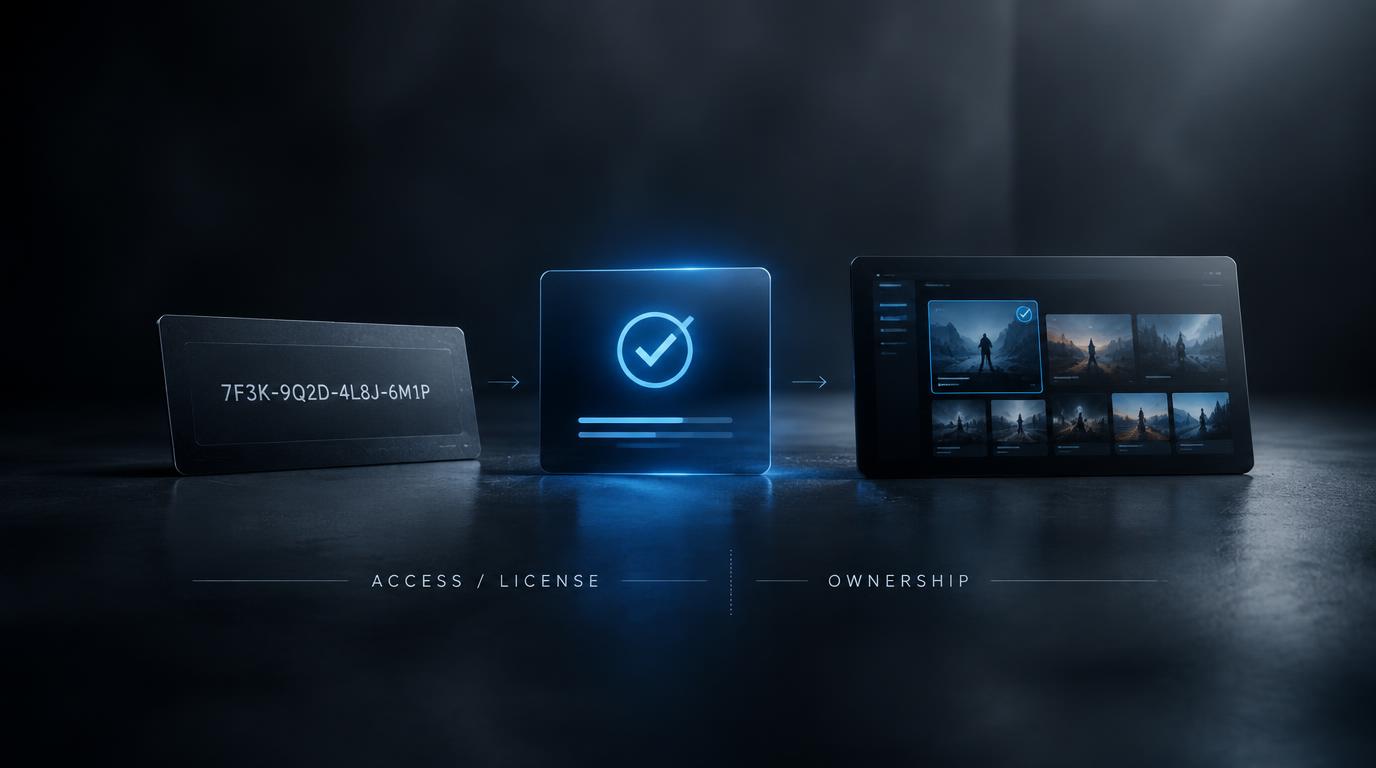
Does Activating a Game Key Mean You Own the Game?
License vs ownership after redemption: account-linked entitlements, Steam as an example, and what buyers should verify first.
11 min read →
Game Key Activation Errors
Fix invalid codes, already redeemed keys, and region failures at activation-plus when to open a marketplace dispute.
9 min read →
DLC Key Activation Guide
DLC key vs base game key: requires ownership errors, season pass rules, Game Pass mismatches, and pre-purchase checklist.
10 min read →
Publisher Key Revocation Audit
Why Steam, Ubisoft & EA revoke keys 3-6 months after activation-chargeback waves, SubID mechanics, escrow gaps & prevention checklist.
12 min read →
Gaming Gift Card Audit
Steam Wallet, PSN, Xbox, and eShop cards: scam patterns, chargeback risk, region locks, and a safer buying checklist.
10 min read →
Game Key Dispute Guide
Evidence pack template, marketplace dispute windows, escrow timelines, and revoked-key refund workflow.
11 min read →Platform Guides
Platform-specific security audits and region lock checklists for Steam, Xbox, PlayStation, and Nintendo.
Steam
Steam Key vs. Shared Account
2026 Steam audit: CD keys vs shared logins-VAC risk, activation safety, and escrow buying guide.
9 min read →
Steam Store Region Lock Guide
Account country, CIS/Global labels, Wallet currency zones, and pre-purchase checklist for Steam keys.
10 min read →Xbox
Xbox Key vs. Shared Account
2026 security audit: retail keys vs shared Xbox accounts, ban risks, ToS compliance, and safe buying checklist.
9 min read →
Xbox Store Region Lock Guide
Account region, 3-month change rule, gift card zones, and pre-purchase checklist.
10 min read →PlayStation

PlayStation Key vs. Shared Account
2026 PSN audit: retail keys vs shared PlayStation accounts-region locks, bans, and buyer checklist.
9 min read →
PlayStation Store Region Lock Guide
Permanent PSN country, US/EU/UK labels, wallet zones, and pre-purchase checklist.
10 min read →Nintendo

Marketplace Reviews
Independent four-pillar audits: escrow, provenance, seller transparency, and dispute resolution.
Difmark Review 2026
Independent four-pillar audit: escrow, provenance, seller transparency, and dispute resolution. Score: 9.1/10.
Audit report →
G2A Review 2026
Independent four-pillar audit: escrow, provenance, seller transparency, and dispute resolution. Score: 7.3/10.
Audit report →
Eneba Review 2026
Independent four-pillar audit: escrow, provenance, seller transparency, and dispute resolution. Score: 8.4/10.
Audit report →
Kinguin Review 2026
Independent four-pillar audit: escrow, provenance, seller transparency, and dispute resolution. Score: 6.8/10.
Audit report →
SCDKey Review 2026
Independent four-pillar audit: escrow, provenance, seller transparency, and dispute resolution. Score: 5.7/10.
Audit report →Research & Methodology
How KeyAuditLab evaluates marketplaces and maps the gray-market landscape. Also see our Digital Pricing & EU Exhaustion Policies and Pre-Purchase Safety Guide.

Frequently Asked Questions
Essential legal doctrines, technical activation parameters, and research methodology standards governing the KeyAuditLab repository.
How does KeyAuditLab verify the accuracy of licensing audits and error fixes? ▼
Each audit is developed through direct empirical testing in clean isolated sandbox environments. Windows activation errors are replicated using legitimate Microsoft product keys under varying slmgr.vbs parameter configurations, and platform region restrictions (Steam, PSN, Xbox, Nintendo) are verified against updated platform Subscriber Agreements and distribution APIs.
Are the software licenses analyzed in this knowledge base legal under EU law? ▼
Yes. Under the European Court of Justice (CJEU) decision in Case C-128/11 (UsedSoft GmbH v. Oracle), the exhaustion doctrine applies to digital software downloads once first sold within the European Economic Area with the copyright holder's consent. However, buyers must ensure they are purchasing authentic individual activation keys rather than unauthorized corporate MAK allocations or prohibited shared accounts.
Why does KeyAuditLab warn against shared account profiles? ▼
Shared account logins violate the Steam Subscriber Agreement, PlayStation Network Terms of Service, and Microsoft Services Agreement. Beyond the risk of account recovery by original owners, concurrent multi-device logins trigger permanent Console Hardware ID (HWID) suspensions. We strictly advocate for official alphanumeric activation keys redeemed directly to your personal credentials.
What should I do if a secondary key activation code fails? ▼
Consult our Activation Error Database or platform-specific region lock guides. If redemption indicates an already-used or region-mismatched code, compile your purchase timestamp, unmodified full-screen activation attempt screenshot, and open a formal dispute within your marketplace's 48–72 hour escrow protection window.