Steam (PC)
ModerateActivates via Steam Client desktop interface. Region locks strictly enforced based on IP geolocation during account creation and billing profile.
Key Rule: Never redeem regional codes via proxy/VPN.
An authoritative investigation into secondary digital gaming markets: answering when buying third-party CD keys is legal under EU Directive 2009/24/EC, French Supreme Court case law, and US EULA rules, comparing Retail vs. Promo vs. Reviewer licenses, mapping Steamworks revocation risks, and evaluating marketplace buyer escrow protocols.
Unlike physical goods, a digital game license is a cryptographic string verified against platform entitlement databases. Understanding how keys migrate from wholesale generation to secondary exchanges reveals why price discrepancies exist and where fraudulent vectors originate.
Diagrammatic trace of legitimate wholesale clearing vs. the illicit chargeback loop.
Publisher requests batch generation in Steamworks, Xbox Live SDK, or PSN Dev Portal. Keys minted at zero marginal cost for MSRP sales, retail discs, or distributor contracts.
Authorized distributors (e.g. Humble, Green Man Gaming, physical disc packers) acquire inventory via volume licensing agreements or promotional charity bundles.
B2B merchants liquidate unsold bundle surplus, physical retail box surplus, or capitalize on legitimate currency exchange arbitrage across approved regional tiers.
Platforms (e.g. Difmark, Eneba) process checkout and hold payouts in a clearing or escrow window while the buyer redeems and verifies the product key.
User inputs 15/25-digit alphanumeric code into Steam/Xbox/PSN client. Entitlement binds irrevocably to account database. Escrow releases funds to merchant.
A frequent concern of consumer protection bodies is whether sub-MSRP game keys are fundamentally counterfeit. Unlike physical hardware, digital goods have zero replication cost. When game studios prepare financial quarterly results, they frequently liquidate bulk allocations of thousands of Steam keys to wholesale aggregators at wholesale discounts of 70% to 85% off retail price.
These bulk inventories are distributed to subscription services (e.g. Humble Choice), hardware manufacturer bundles (e.g. Intel/AMD game promo bundles), and regional physical distributors. When consumers or corporate aggregators receive surplus keys they do not intend to activate, they liquidate them on open digital marketplaces. This mechanism represents economic arbitrage, not piracy.
Major game publishers historically practiced regional price discrimination, selling identical digital licenses at lower nominal prices in emerging economies (such as Eastern Europe, LATAM, or Southeast Asia) to match local purchasing power. Secondary market traders rapidly established cross-border arbitrage channels, acquiring cheaper regional codes and reselling them globally.
In response, platforms like Valve and Sony implemented strict territory restriction flags (Region Locking). An authentic key generated for Region CIS or LATAM will fail validation on a European or North American account unless activated through misleading VPN proxy tunnels, a practice that constitutes grounds for platform account suspension under Section 3 of the Steam Subscriber Agreement.
Short answer: Yes, buying unused game keys is legal. Purchasing a digital activation code from wholesale surplus, retail stock, or unbundled subscriptions does not break copyright law in the EU, US, or UK. Legal problems and key revocations only happen when a seller supplies keys obtained with stolen payment cards, resells free press codes, or sells shared platform accounts instead of standalone keys.
Under Article 4(2) of the EU Computer Programs Directive (2009/24/EC) and CJEU Case C-128/11 (UsedSoft), digital exhaustion applies to perpetual standalone software (such as Windows or Office) first sold in the EEA.
Following CJEU precedent on hybrid multimedia works, digital video games are governed by the Information Society Directive (2001/29/EC). Tangible boxed discs and printed cards enjoy physical first-sale exhaustion, while online downloads are treated as service access.
After a 2019 Paris first-instance win for consumers, the Paris Court of Appeal overturned the ruling in October 2022. On October 23, 2024, France's Supreme Court (Cour de cassation, Case No. 23-13.738) definitively dismissed the consumer appeal, confirming that video games fall under Directive 2001/29/EC (InfoSoc) rather than UsedSoft.
| Jurisdiction | Governing Statute / Doctrine | Status of Unredeemed Keys | Status of Activated Account Content |
|---|---|---|---|
| European Union (EU) | Directive 2001/29/EC (InfoSoc) & UFC-Que Choisir v. Valve (2024) | Lawful for buyers to purchase genuine surplus; publisher contracts govern distributor resale | No statutory resale right; account transfers barred by platform ToS |
| United States (US) | 17 U.S.C. § 109(a); Vernor v. Autodesk (621 F.3d 1102) | No statutory copyright exemption for EULA-restricted software; governed by contract terms | Classified as non-transferable personal license grant (Vernor restricts resale) |
| United Kingdom (UK) | Copyright, Designs and Patents Act 1988 (Retained EU law) | Lawful unactivated bearer token distribution | Enforced through contractual digital service agreements |
Critical Takeaway: Trading unactivated, virgin game keys (bearer tokens) is globally recognized as legitimate commercial commerce. What platforms strictly prohibit is the sale of whole accounts or pre-activated profiles, which violate End User License Agreements (EULA).
A key code on a marketplace looks identical regardless of its generation channel. However, its legal origin determines whether you receive a perpetual consumer license or a high-risk promotional grant susceptible to immediate publisher revocation.
Generated by publishers for authorized boxed disc copies or official commercial digital distributors (GMG, Fanatical, Humble Store).
Allocated to hardware partners (Nvidia, AMD, Intel) bundled with GPUs/CPUs. Frequently subject to redemption window deadlines.
Minted with zero royalty via Steamworks "Release State Override" for journalists, curators, and Twitch/YouTube content creators.
Surplus keys unbundled by consumers from curated charity or subscription tiers (e.g. Humble Choice, Fanatical Bundles).
Risk tiers above summarize documented publisher revocation patterns and licensing rules under the KeyAuditLab Audit Methodology.
| License Category | Primary Distribution Source | EU / CJEU Legal Status | Publisher Revocation Risk | Buyer Protection & Escrow Advice |
|---|---|---|---|---|
| Retail Key (Standard Commercial) | Physical disc boxes, authorized wholesale distributors, direct digital stores | Lawful commercial origin (InfoSoc Art. 4 for boxed media; EULA terms for digital) | Minimal (Unless wholesale batch stolen) | Redeem immediately upon delivery; lowest revocation exposure in secondary trade. |
| Promotional Key (Hardware / OEM) | Nvidia / AMD / Intel hardware promotions, pre-built gaming PC bundles | Lawful to redeem when unused; bound by vendor promo & OEM terms | Moderate (Risk of promo expiry date) | Must verify activation deadline immediately; some require hardware-specific GPU bridge. |
| Reviewer / Press Copy (Curator Token) | Keymailer, Woovit, direct PR studio outreach, media review codes | Prohibited resale ($0 non-commercial evaluation grant) | Severe (Mass-revoked when flagged) | High revocation risk. Studios audit leaked influencer batches and delete entitlements. |
| Resold Bundle Surplus | Humble Choice, Fanatical Bundles, charity digital bundles | Paid consumer surplus; lawful to redeem unused codes (subject to bundle ToS) | Low (Valid commercial origin) | Genuine duplicate surplus; safe to purchase when seller verified via marketplace escrow. |
Not all listings on secondary platforms deliver goods in the same format. The technical delivery mechanism directly determines account safety, revocation vulnerability, and warranty coverage.
Delivery occurs via an OAuth 2.0 handshake directly connecting the retailer's store to your Steam, Epic Games, or PSN library without exposing raw alphanumeric text.
A discrete alphanumeric string (e.g. 5x5 for Microsoft, 3x5 for Steam). Operates as a bearer token that transfers entitlement permanently upon redemption.
A title purchased as a gift and sent directly to a recipient account. Since May 2017, Valve discontinued storing new gifts in Steam inventories or sending gift email links.
Seller delivers login credentials (username/password) to an account containing the game rather than a standalone code. Direct breach of SSA Section 1.
When a game disappears from a user's library with the alert "Your recent Product code activation has been revoked due to a problem processing payment for this item," the publisher or platform has invalidated that key batch.
Valve does not expose a public key-banning Web API; instead, developers use the Ban or Disable Steam Keys tool inside the Steamworks Partner Dashboard. Publishers upload a .txt list of flagged keys (recommended in batches of up to 10,000) and choose whether to disable unactivated codes or revoke already redeemed licenses.
Credit card chargebacks often appear weeks or months after a transaction. Escrow-backed marketplaces delay merchant payouts during an initial verification period and retain platform mediation tools so buyers can freeze contested orders immediately when a key fails activation or is flagged early.
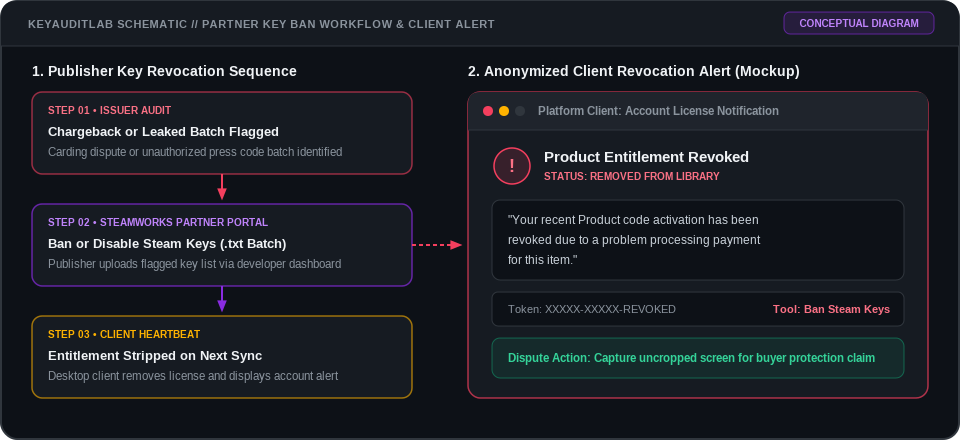
To understand why secondary escrow is non-negotiable, examine these landmark industry crises where developers executed mass key invalidations via Steamworks:
Indie publisher TinyBuild (creators of SpeedRunners and Punch Club) reported in June 2016 that roughly 26,000 keys with an estimated $450,000 retail value had been bought using stolen credit cards and resold on G2A, leaving the studio with chargeback losses.
When G2A asked for a list of suspect codes to investigate, TinyBuild declined to turn over keys or mass-revoke them from players' accounts, explaining that deactivating already redeemed licenses would unfairly punish innocent downstream buyers rather than the fraudsters.
Renowned publisher Devolver Digital (publishers of Hotline Miami, Cult of the Lamb) adopted an aggressive public stance against secondary key resale, warning that keys purchased from unauthorized resellers are subject to immediate, zero-notice cancellation.
Devolver regularly battles key-begging scammers who impersonate real Twitch/YouTube creators using spoofed email domains to request promotional review keys. Once identified, Devolver invalidates flagged batches via the Steamworks Ban Steam Keys dashboard tool, voiding any resold review copies.
Upon the release of Sniper Elite 3, developer Rebellion detected that a compromised PC distributor had 7,050 Steam keys stolen prior to billing clearing. These keys were distributed across dozens of retail broker outlets.
Valve and Rebellion carried out a simultaneous mass-revocation of all 7,050 activation codes. Thousands of players logged in to discover the game removed from their libraries. Platforms with robust escrow insurance refunded their users; unregulated forums left buyers with zero money and no playable title.
Our laboratory evaluated secondary platforms based on four empirical consumer protection indicators: default escrow inclusion, seller KYC vetting stringency, transparent delivery categorization, and formal dispute resolution SLAs.
| Evaluation Criteria | Difmark | G2A | Eneba | Kinguin |
|---|---|---|---|---|
| Buyer Protection Model | Escrow payout hold; no paid protection tier (payment fees may apply) | Free Money Back Guarantee (G2A Plus is for discounts, not disputes) | Built-in Buyer Guarantee & support mediation | Paid Buyer Protection add-on at checkout |
| Delivery Format Clarity | Key vs. Account listings labeled | Clear product titles & seller listings | Distinct account/key filtering | Labeled in listing specs |
| Merchant KYC Vetting | Seller verification & ID checks | Business seller verification tiers | Commercial entity compliance | Merchant audit checks |
| Dispute Rules & Window | 14-day refund window; requires clicking "Escalate to claim" | Conversations tab; up to 7-day seller wait before escalation | 14-day pre-reveal refunds; proof ticket if key revealed | Ticket center (limited recourse if add-on skipped) |
| 2026 Policy Review |
Escrow-held P2P marketplace; watch key vs. account tags
Read Difmark Policy Audit
|
Extensive catalog; verify seller rating & save chat logs
Read G2A Safety Audit
|
Competitive EU pricing; verify service fees at checkout
Read Eneba Safety Audit
|
Established marketplace; factor Buyer Protection fee into cost
Read Kinguin Support Audit
|
Audited against published marketplace terms of service and consumer protection frameworks as of November 2026.
Activates via Steam Client desktop interface. Region locks strictly enforced based on IP geolocation during account creation and billing profile.
Sony PlayStation Network (PSN) vouchers are immutable per country store. A US code cannot redeem on an EU/UK account under any circumstances.
Redeemed via Microsoft Account portal. Cross-entitlement (Play Anywhere) grants both PC and console versions when supported by publisher.
16-character alphanumeric vouchers activate on the Nintendo eShop. Nintendo blocks changing your account region while any eShop wallet balance remains.
Marketplace Audit Methodology · Marketplace Landscape 2026 · Complete Steam Account vs Steam Key Guide · Does Activating a Game Key Mean You Own the Game? · Universal Region Block & Regional Lockout Guide · Publisher Key Revocation Investigation · Game Key Dispute & Chargeback Protocol · Activation Error Code Database · DLC & Expansion Key Compatibility · Digital Gift Card Secondary Audit.
If you want sub-MSRP pricing while following every safeguard in this audit, our benchmarked partner Difmark aligns directly with the security criteria covered above:
Unlike platforms that sell a separate paid Buyer Protection add-on at checkout, Difmark holds merchant payouts in escrow by default with no protection subscription.
Listings separate standalone CD keys from account offers so you can avoid shared account logins and activate keys directly on your own personal profile.
Instant key delivery lets you redeem and verify immediately inside the 14-day refund window, backed by screenshot escalation via My Orders if a key fails.
Supports major reversible payment rails (Visa, Mastercard, Apple Pay, Google Pay) alongside regional methods so you retain card-level dispute protection.
* Transparency Notice: This is a sponsored partner link. If you choose to purchase through Difmark, KeyAuditLab may earn a referral commission at no extra cost to you. All security benchmarks and marketplace rules on this page remain strictly independent.
Authoritative legal and technical answers for buyers navigating secondary digital gaming markets.
Yes, purchasing unused digital game keys from legitimate retail or bundle surplus is lawful across the EU, the US, and the UK, and you will not be banned for redeeming a genuine retail CD key on your own account. Note that EU software exhaustion (Directive 2009/24/EC / UsedSoft) applies to standalone utility software, whereas digital games fall under Directive 2001/29/EC and platform subscriber agreements (upheld in UFC-Que Choisir v. Valve, Oct 2024), which bar account transfers rather than unredeemed retail codes. Bans and revocations occur only when buyers purchase pre-loaded accounts, bypass regional locks via VPN, or redeem keys acquired with stolen cards or leaked press codes.
• Retail Keys: Minted for primary commerce. Royalties are paid to publishers and revocation risk is minimal unless a distributor batch is stolen prior to clearing.
• Promotional / OEM Keys: Distributed with hardware (GPU/CPU). Safe if activated before expiration dates, but may carry hardware verification locks.
• Reviewer Copies: Issued at $0 for media/curators. Selling them violates developer agreements. Publishers routinely revoke these if found on marketplaces.
• Resold Bundle Surplus: Individual unredeemed codes from legitimate packages (Humble, Fanatical) with very low revocation risk.
Publishers invalidate key batches via the Steamworks Ban Steam Keys tool when inventory is linked to theft, payment fraud, or social engineering scams. For example, in 2014 Rebellion and Valve revoked 7,050 stolen Sniper Elite 3 keys, and Devolver Digital routinely disables phished review codes obtained by scammers posing as influencers. By contrast, in 2016 TinyBuild reported roughly $450,000 in carded keys on secondary markets but declined to mass-revoke them to avoid punishing innocent players. When revocations occur, only buyers covered by marketplace buyer protection or payment disputes can recover funds.
Authorized retailers source keys directly from game publishers under wholesale distribution contracts with guaranteed commercial licensing. Secondary marketplaces operate peer-to-merchant platforms where independent sellers list surplus keys, regional price variations, or bundle overstock, requiring escrow protection to safeguard buyer funds.
Buyer escrow holds payment in an isolated clearing account during a post-delivery verification window. Funds are only remitted to the merchant once the customer redeems and verifies the product key without an active dispute.
Buying pre-created accounts directly breaches Section 1 of the Steam Subscriber Agreement and console network terms. Publishers routinely detect IP and geolocation shifts, resulting in permanent account bans. Authentic keys activate directly onto your primary personal profile with zero ownership risk.
Yes. Through the Steamworks Partner Dashboard (Ban or Disable Steam Keys tool) or console publisher portals, developers can upload flagged key batches tied to payment fraud, stolen wholesale stock, or leaked review codes. When executed, the title is removed from the buyer's library. Marketplaces that hold seller payouts in escrow or enforce buyer protection policies give users a structured claim path to seek refunds.
Direct Entitlement links your store account via OAuth so authorized retailers activate games directly with minimal revocation exposure. A digital CD Key is a 15-to-25 character alphanumeric token that binds permanently upon manual redemption and should be tested immediately after purchase. A Steam Gift is sent directly to a friend's account (Valve discontinued storing new gifts in inventories in May 2017) and is blocked if regional prices differ by 10% or more.
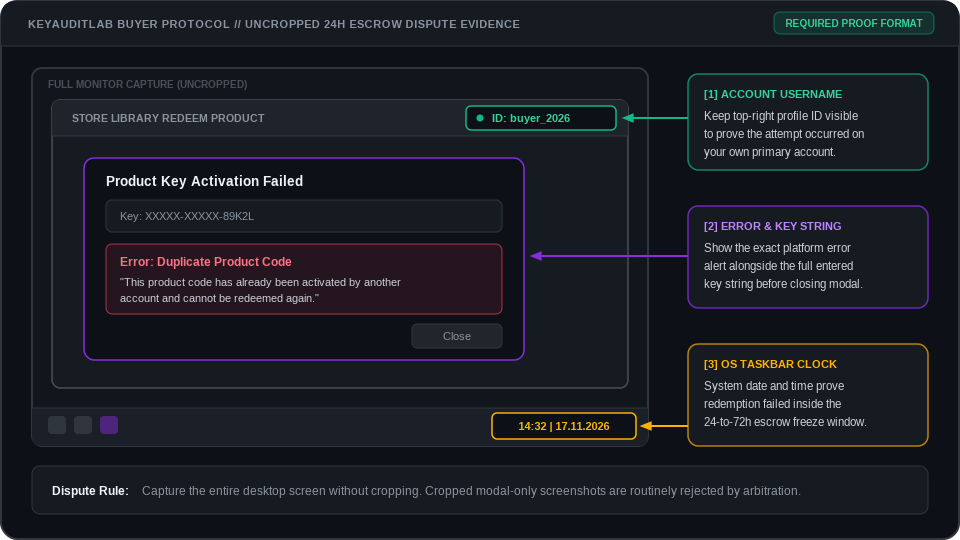
Capture an uncropped desktop screenshot displaying the platform error message, your account username in the top corner, and the Windows taskbar with date/time, then open an internal marketplace ticket within 24 hours while escrow funds remain locked.